
In 1905, a Tammany Hall ward boss named George Washington Plunkitt sat for a series of interviews and explained, with a frankness no modern consultant would survive, how to hold an immigrant district. "I don't trouble them with political arguments," he said. "I just study human nature and act accordin'." If a family was burned out of their tenement, Plunkitt didn't refer them to a charity that would "investigate their case in a month or two." He got them quarters, bought them clothes, and fixed them up "till they get things runnin' again." He found their sons jobs. He went to their weddings and their funerals. He asked one thing in return, and it wasn't agreement.
The reformers who opposed him — the "goo-goos," good-government men with college degrees and lectures about civic virtue — he dismissed as "morning glories": looked lovely in the mornin' and withered up in a short time. The machine, he said, was made of "fine constant oaks."
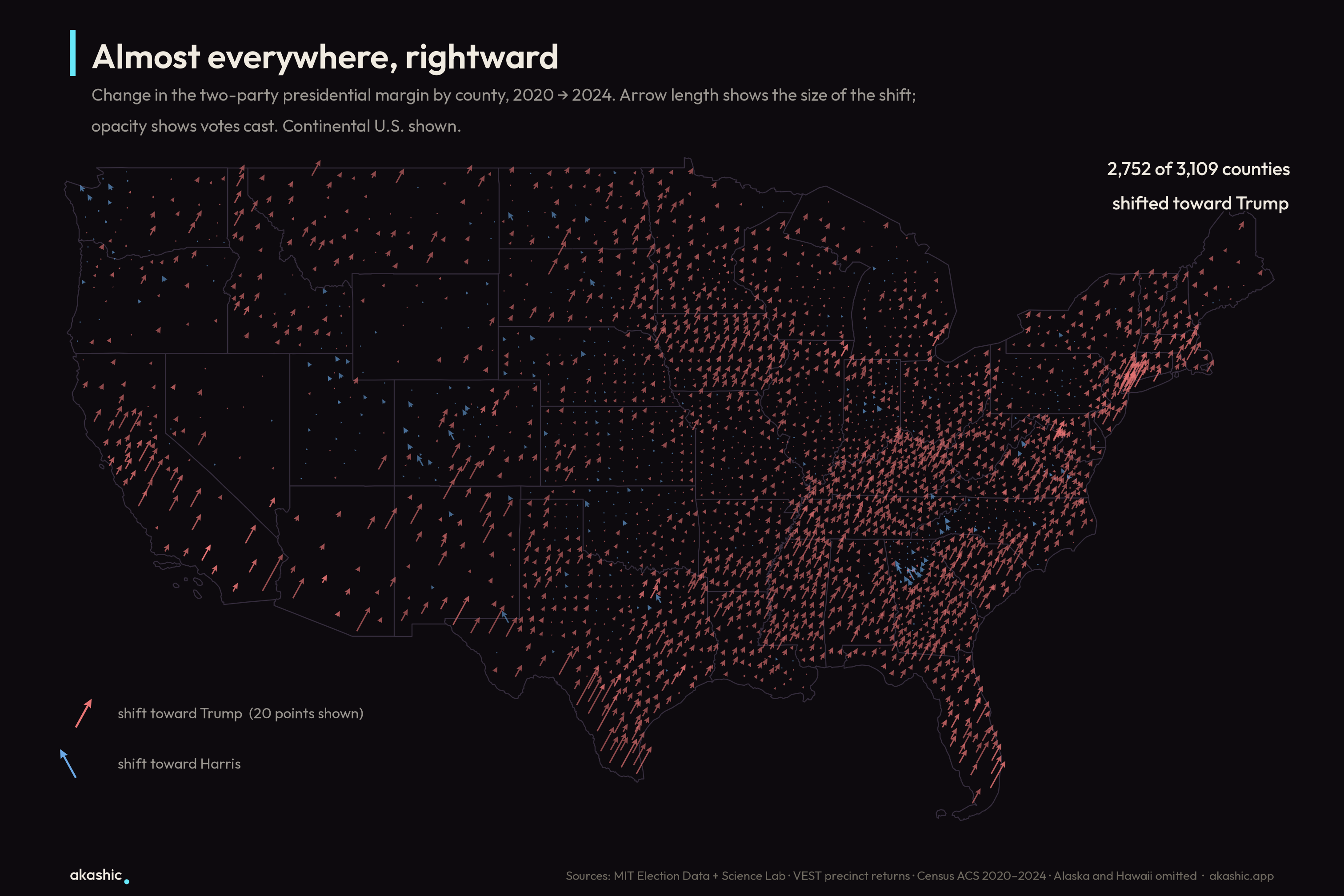
A hundred and twenty years later, we ran a statistical model over every American county and every city of more than ten thousand people, asking which community traits predicted the great rightward swing of 2024. The model knew nothing about Plunkitt. It found his district anyway.
What the data shows
The headline result, from 3,140 counties and 4,155 cities: the single strongest predictor of a community's movement toward Trump between 2020 and 2024 — stronger than race, stronger than income, stronger than religion, stronger than anything else the Census Bureau measures — was the share of its residents who speak a language other than English at home.
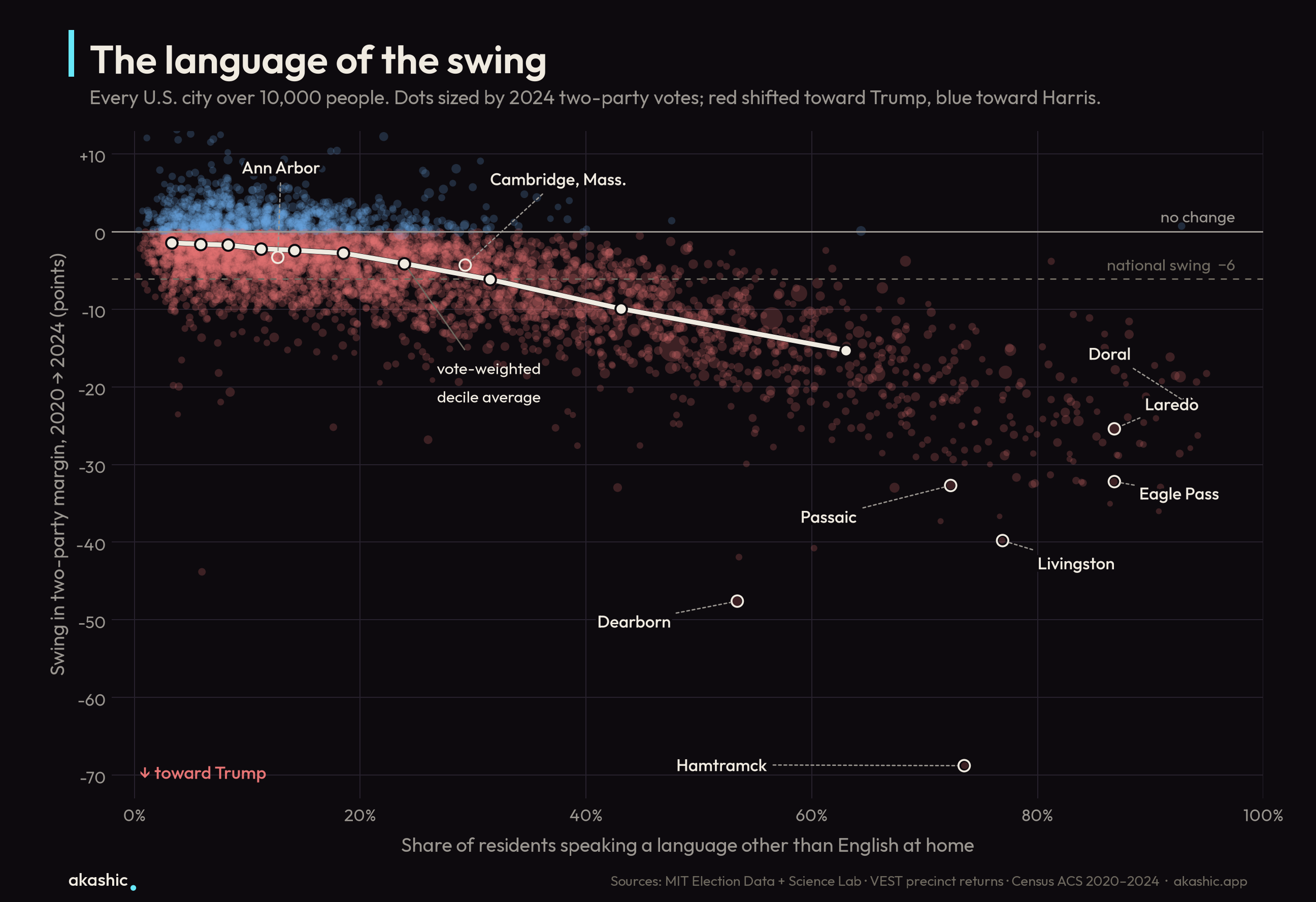
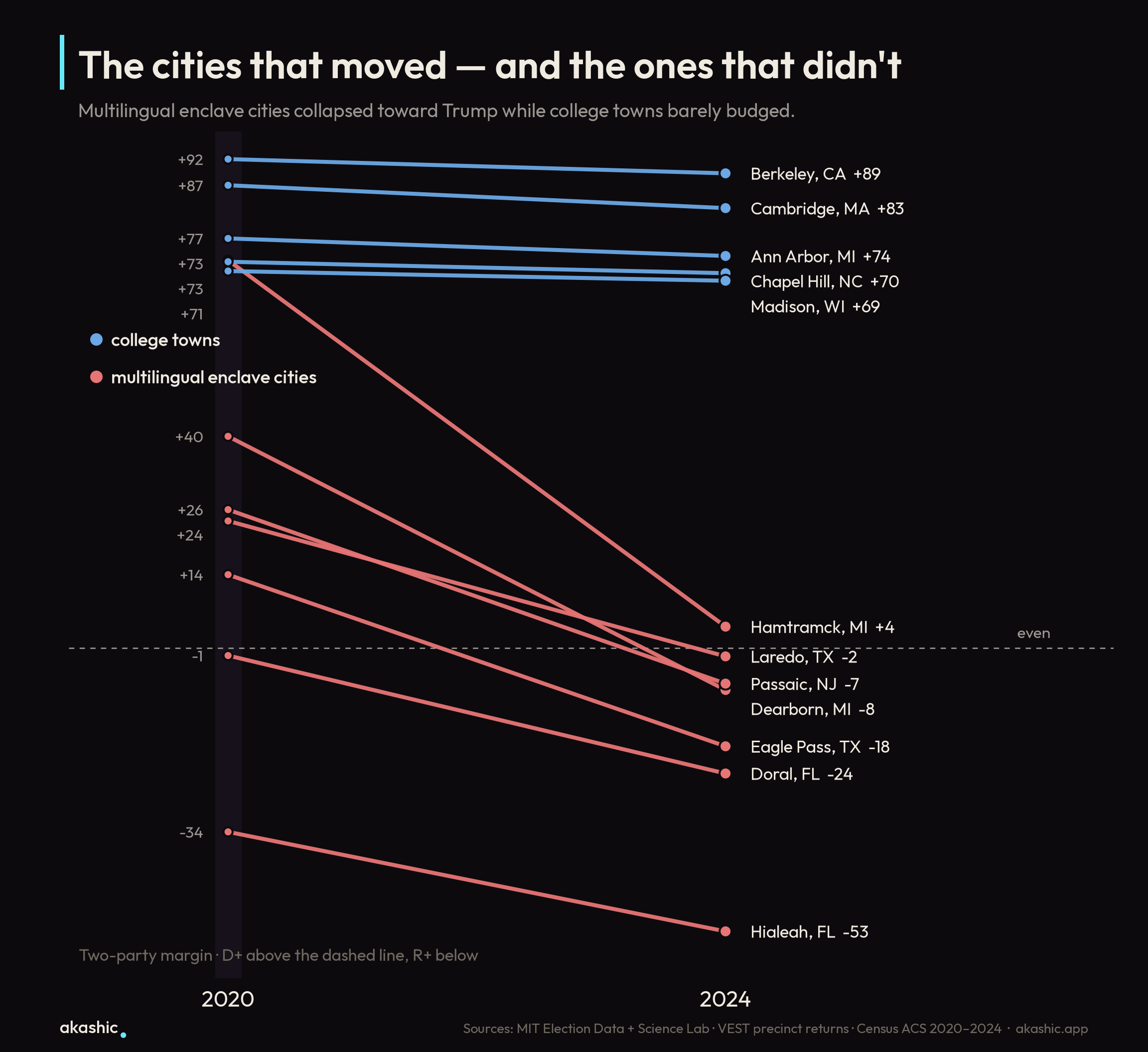
The relationship is close to a straight line down. English-only towns barely moved. Cities where a quarter speak another language at home fell four points; cities where half do fell ten or more. Eagle Pass, Texas — 87 percent non-English — went from Biden by 14 to Trump by 18. Doral, the Venezuelan heart of greater Miami: from a dead tie to Trump by 24. Passaic, New Jersey, a Dominican mill city: 33 points right. Hamtramck, Michigan, the most Democratic city in the Midwest in 2020: 69 points. Statistically, the language effect is eight times its margin of error. And here is the finding inside the finding: once the model knows the language number, knowing how Hispanic a place is adds nothing it can tell apart from zero — strip Hispanic share out of the model entirely and the language signal only sharpens. The "Hispanic swing" was a language swing — concentrated precisely in the communities still living partly in another tongue, the first- and second-generation America that the Democratic Party considered its inheritance.
Pulling the other way, only one broad trait held communities against the tide, and only faintly: college degrees. While the nation moved six points, Ann Arbor moved three, Chapel Hill two, Madison a point and a half the other way. It is a counter-current about a fifth the size of the language effect — a footnote to the main story, not a rival to it.
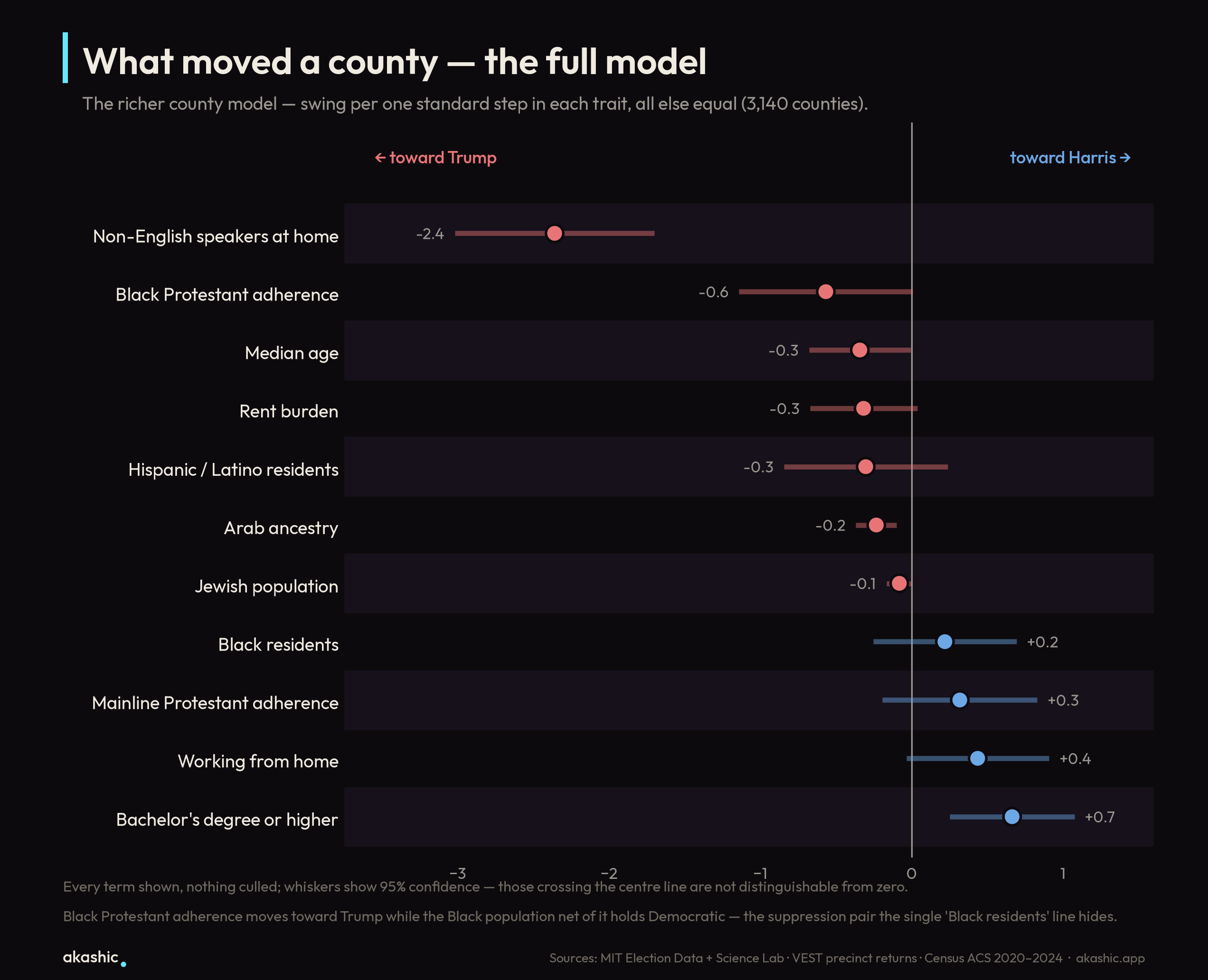
So the 2024 election sorted America's communities mainly along one axis — distance from the immigrant experience — with the diploma a fainter counter-current. The question is why, and the answer that fits best is older than polling.
A third pattern, smaller and county-only, points straight at it. Split America's Black population by churchgoing and the halves pull apart: counties dense with Black Protestant congregations — the historically Black churches — drifted toward Trump, while the Black population net of them held Democratic. It is a Southern effect, and it is the most telling in the dataset, because the historically Black church is not a metaphor for a machine. In much of the South it was the machine — the institution that turned out the vote, delivered the help, and knew its people by name. Where it is strongest, 2024 moved the way machines move. (The measure is county-level, and the 2020 religion census undercounts Black denominations, so read it as a lead — but it is the lead that opens everything that follows.)
The oldest coalition in America
The political machine is the most durable invention in American urban history, and it was built on a precise insight: people navigating a new country in a second language do not experience politics as a debate about principles. They experience it as a question of who shows up. The machine showed up. It met the boat. It traded coal in winter and jobs at the docks and protection from an indifferent bureaucracy for the one thing its constituents had — votes. It was corrupt, openly so; Plunkitt called his method "honest graft" and saw his opportunities and took 'em. And for a century, in New York and Boston and Chicago and Kansas City, the immigrant neighborhoods stayed loyal to it, while the educated classes — comfortable, procedural, scandalized — voted for reform.
American politics, in other words, has run this experiment before: offer the newest, most precarious Americans a transactional, personal, delivery-based politics, and offer the secure a politics of norms and institutions, and see who takes which. The result was the same for a hundred years. It was never close.
The machines were mostly Democratic, but not always — and the greatest Republican machine in the country ran Philadelphia, under the Vare brothers, on exactly Plunkitt's model. Which brings us to the most instructive picture in this entire dataset.
Philadelphia, 1932
In 1932, in the deepest trough of the Depression, Franklin Roosevelt carried the nation by eighteen points and carried almost every big city in it. He did not carry Philadelphia. The Vare organization — service politics, ward by ward, favor by favor — held the city for Herbert Hoover, of all people, in the worst Republican year of the century. A machine at full strength can do that: it can hold its people against a hurricane, for one election.
Then came 1936.
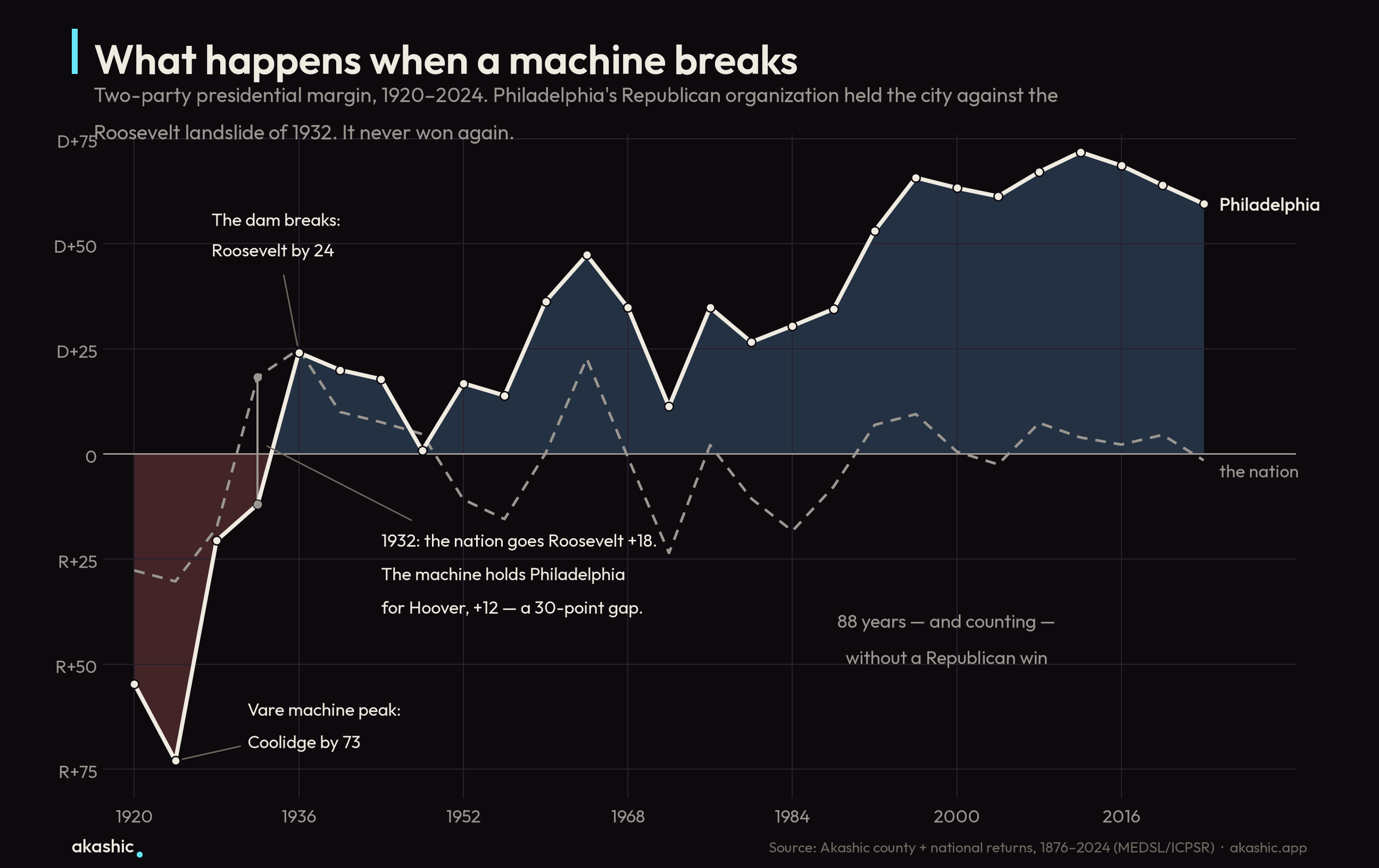
Roosevelt didn't just win Philadelphia in 1936; he won it by 24, a 36-point collapse in one cycle. The machine's families had discovered that the New Deal delivered more than the ward boss did — that one side of politics was handing out jobs, checks, and protection at a scale no clubhouse could match. The dam broke. In the 88 years and 22 presidential elections since, Philadelphia has never voted Republican again. That is what it looks like, in data, when a clientelist loyalty snaps: it holds absolutely, until it transfers absolutely.
Keep that shape in mind.
Boss politics, 2024
Now look at the Trump coalition's offer through Plunkitt's eyes rather than a pundit's. No tax on tips. No tax on overtime. Stimulus checks with his signature on them — the first president to put his name on Treasury disbursements, something even machine bosses only dreamed of. Tariffs sold not as trade theory but as protection — that fine old machine word — for your job, your plant, your town. Pardons dispensed as personal favors to the loyal. Endorsements and primaries operated as a patronage ledger. A persecution narrative — they're really coming after you; I'm just in the way — that converts a politician's legal trouble into kinship with every voter who has ever been on the wrong side of an indifferent system. None of this is an aberration of American politics. It is one of the two great traditions of American politics, the one that built every city machine from Tammany to Daley, returned to the national stage after the reformers thought they'd buried it.
And it now runs in both directions. The same logic governs the top: a golden share in U.S. Steel as the price of a merger; an equity stake in Intel as the price of subsidy; chipmakers handing the Treasury a cut of their China revenue as the price of an export license. Call it industrial policy or call it what a ward boss would recognize instantly — you want to operate in my district, you pay the organization. Clientelism below, clientelism above. The machine is the model at every scale.
Some commentators reach for "socialism" or third-world comparisons to describe this. The data argues otherwise, and the voters themselves argue louder. The two American cities most fluent in actual expropriation — Doral and Hialeah, full of families who fled Caracas and Havana — moved toward Trump harder than almost anywhere in America. They did not mistake him for a communist. They recognized something else, something familiar from the politics of the places they left and the wards their grandparents passed through here: a patrón. The accurate American word is older and homegrown: a boss.
The uncomfortable part, stated carefully
Exit polls found that voters who named "the state of democracy" as their top concern broke overwhelmingly for Harris — and that those voters were disproportionately the secure: college-educated, comfortable, fluent in the system's own language. It is tempting, staring at our language gradient, to draw an ugly conclusion — that some Americans can't conceive of democracy the way others do.
The data supports a humbler and more damning reading: not capacity, but priority. Procedural democracy is a concern you purchase after the rent. Our own model says so in numbers: the most rent-burdened counties leaned toward Trump, while cities full of work-from-home professionals — the most materially insulated class in the country — held for Harris. The communities that broke rightward were not voting against democracy. They were voting the way new and precarious Americans have voted since the 1850s: for whoever made the most concrete, most personal, most deliverable offer. In 2024, one party ran on the Constitution. The other ran on the price of eggs and the memory of checks with a signature on them. Plunkitt could have called the result from his perch at the New York County courthouse, and it would not have taken him a regression to do it.
The reformers' coalition has always had this weakness: its central good is abstract, and abstractions are a luxury good. That is not a slander on anyone's values — it is the finding. The slander would be pretending the diploma class votes on democracy because it is virtuous, rather than because it can afford to.
1928, 1932, or 1936?
So the question that should keep Democratic strategists awake is not why did this happen — Plunkitt answered that — but which year is it. Was 2024 the immigrant cities' 1932, a one-cycle defection under extraordinary pressure, recoverable when prices cool? Or their 1936 — the dam breaking, loyalty transferring to whichever organization delivers?
There is a third date on the wall, and it fits the shape of this better than either. In 1928, Al Smith — Catholic, Tammany-bred, anti-Prohibition — lost the country to Herbert Hoover by seventeen points and carried the immigrant cities anyway. He flipped Massachusetts and Rhode Island, two of the most heavily Catholic states in the union, and erased the Republican edge in the twelve largest cities. He lost, and in losing he revealed the coalition that would govern for a generation. V.O. Key built his theory of critical elections on that one result; Samuel Lubell called it the Al Smith Revolution. The cities had begun to move. It took eight more years and a depression to finish the move.
2024 is that picture run backwards: the same enclave cities, beginning the same kind of move — only now away from the party that once met their boats, not toward it. The data has an opinion about how far along that move is. It is not comforting for the blue side of the ledger — but it is not the dam-break either.
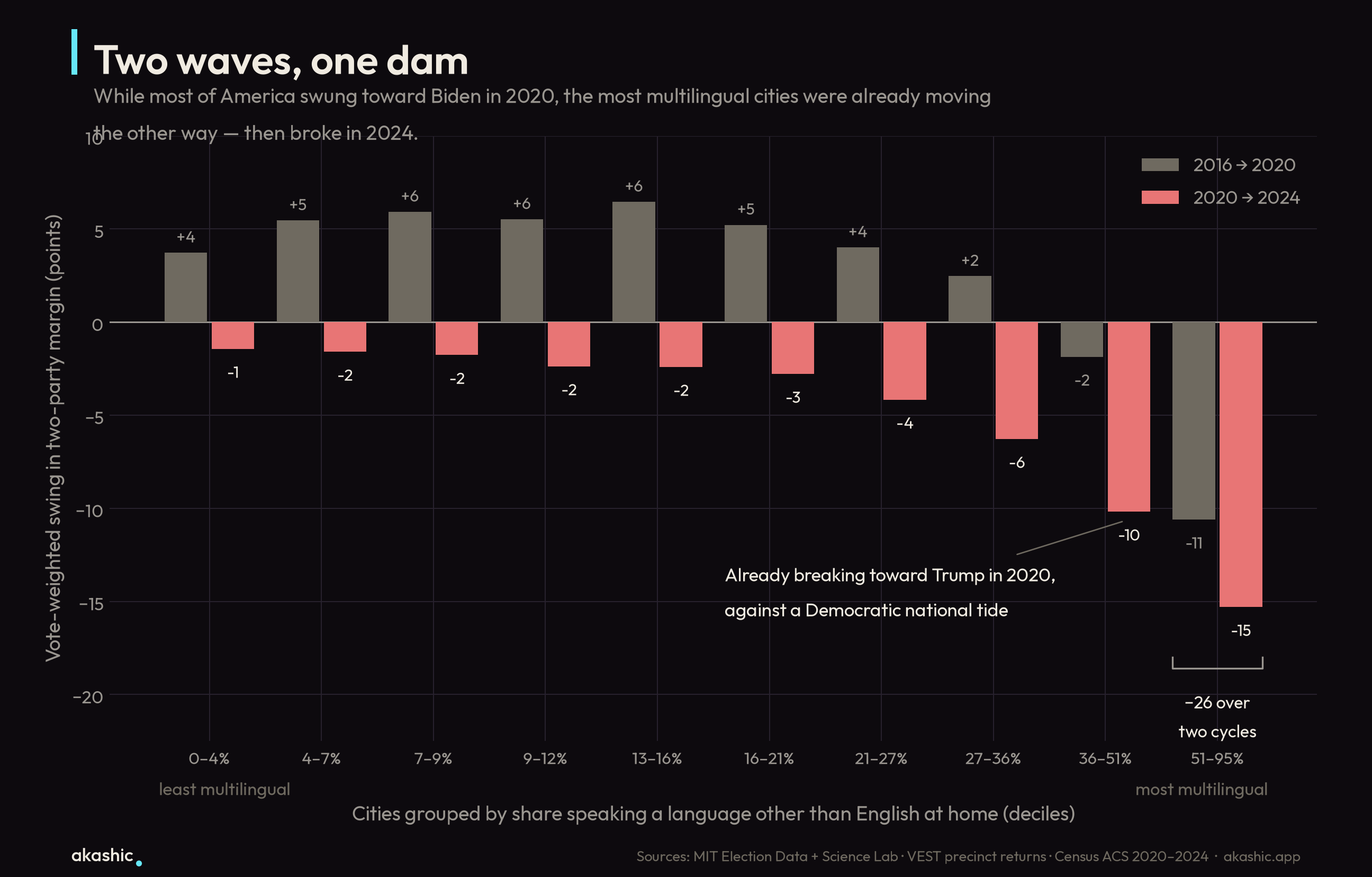
2024 was not the first wave. It was the second. Between 2016 and 2020 — while the rest of the country was swinging four, five, six points toward the Democrats — the most multilingual tenth of American cities was already moving the other way, by eleven points. Then another fifteen. The least multilingual deciles round-tripped: out with Biden, back with Trump, net nothing. The enclave cities moved in one direction across eight years, through two wildly different national environments, by twenty-six cumulative points. That is not a protest. That is a realignment in progress — the Philadelphia shape, half-finished.
But the Philadelphia story carries a second lesson, and it cuts the other way. Machine loyalty is the most conditional loyalty in politics. The Vare machine didn't lose Philadelphia to a better argument; it lost to a better delivery system. Transactional voters are exactly the voters you can lose transactionally. A boss who does not deliver — whose prices stay high, whose protection proves hollow, whose favors flow only upward to the steel mergers and the chip stakes — is just a politician with your expectations on his desk. The Democrats' opening, if there is one, is not a louder seminar on democratic backsliding. It is the oldest play in their own book, the one they ran in 1936 and seem to have forgotten they wrote: show up, deliver, and put your name on it.
And the early returns are already testing that loyalty. In the eighteen months after November 2024, the machine vote began to drift back — not in the seminar rooms but in the precincts this analysis is about. Arizona's Seventh, a majority-Hispanic district running down to the border and the kind of place this whole story is about, ran about eighteen points to the left of its 2024 presidential line in the September 2025 special election. New Jersey, which Harris had carried by 5.9 points in 2024, elected a Democratic governor by 14.4 the next fall. Virginia produced the largest Democratic gubernatorial margin since 1961. By the spring of 2026, Trump's approval had fallen to 37 percent in the NYT/Siena poll and to 39 at AtlasIntel — the most accurate pollster of the last two cycles — its worst reading of his second term, with the generic ballot at Democrats by eleven. None of this is a 2028 result, and off-year and special electorates are smaller and more engaged than presidential ones. But the direction is the tell. Transactional voters drifting back when the prices stay high is not a sign the 2024 coalition was a mirage; it is that coalition behaving exactly as a machine vote behaves — present at the window, asking what you have done for it lately.
There is one more asymmetry, and it is the reason 2024 reads more like 1928 than 1936. A realignment's losers are not all equally stranded. When the New Deal carried the immigrant cities away from the Republicans, it stranded a party that had never been the workingman's: the party of Lincoln and the Union and sound money held no people's-party deed to reclaim, and it took half a century and an entirely different coalition to win that vote back. The party losing the machine vote now holds the asset its predecessors lacked — a century and a half as the party of the common man, from Jackson to Bryan to the New Deal. That deed is still in the drawer. Whether it is worth anything turns on the same thing it always did: delivery. A deed you never act on is just paper, and the machine vote has never been sentimental about paper.
The machine always knows its own. 2024 was the tell, not the lock — the enclave cities have begun to move the way they began to move in 1928, and the returns since suggest the move is not yet a transfer. Which organization the newest Americans finally decide is theirs will be settled the way it has always been settled: not by the better argument, but by the better delivery.
Method, briefly: weighted least-squares models of the change in two-party presidential margin, 2020→2024, across 3,140 counties (certified MEDSL returns) and 4,155 cities over 10,000 population (VEST precinct returns aggregated through census blocks; 49 cities with allocation failures excluded). Predictors from Census ACS 2020–2024 (religious adherence from the 2020 US Religion Census, county-level), standardized; state fixed effects; errors clustered by state and county. Two pre-specified models, no stepwise selection: a demographic core run on both tiers, and a richer county model adding the concentrated terms (Arab ancestry, the Protestant traditions) as first-class predictors. Income and population density were trimmed from the core on theory and confirmed null; the 2020 result is excluded as a predictor (the swing is measured from it). The language finding holds in a citizens-only specification, with or without Hispanic share, and is the one effect untouched by every variation we tried; the Black-church split is county-only and, given the census's undercount of Black denominations, a floor. City-level results are careful estimates, not certified municipal returns. Historical Philadelphia and national series from the Akashic county returns, 1876–2024. These are community-level patterns: when a city swings, the data cannot see which neighbors moved, and an explanation is not a proof. The post-2024 results in the closing section are certified state returns (New Jersey and Virginia, 2025) and the Arizona Seventh special election (September 2025); the national approval and generic-ballot figures are from the NYT/Siena and AtlasIntel public releases of spring 2026. Full regression tables, residual lists, and code live in the project repository under data/analysis/swing-regression/.