Virginia's Redistricting Referendum: A Partisan Map with a Demographic Twist
Yes won by 2.9 points — but ran 12.4 behind Spanberger. The April 2026 electorate tells a coalition story the Nov 2025 result hid.
What Happened on April 21
Virginia voters approved the Democratic-sponsored constitutional amendment
allowing the General Assembly to redraw congressional districts for the
remainder of the decade. The margin was 1,575,288 Yes to 1,486,229 No —
51.45% to 48.55%, a 2.9-point Yes win with 133 of 133 localities reporting.
That narrow margin is the story. Democrats got their map. But the Yes
coalition was significantly smaller than the one that elected Governor
Abigail Spanberger five months earlier, and the shape of where support
came from diverged from both the 2025 gubernatorial and the 2024
presidential results in ways worth understanding heading into the 2026
House midterms.
vs 3,433,340 for Gov 2025 and 4,482,576 for Pres 2024
At the precinct level, the pattern is dense: 2,514 of 2,534 Virginia
precincts, coloring each by its Election Day Yes–No margin.
!Virginia referendum Yes-No margin by precinct — Election Day votes
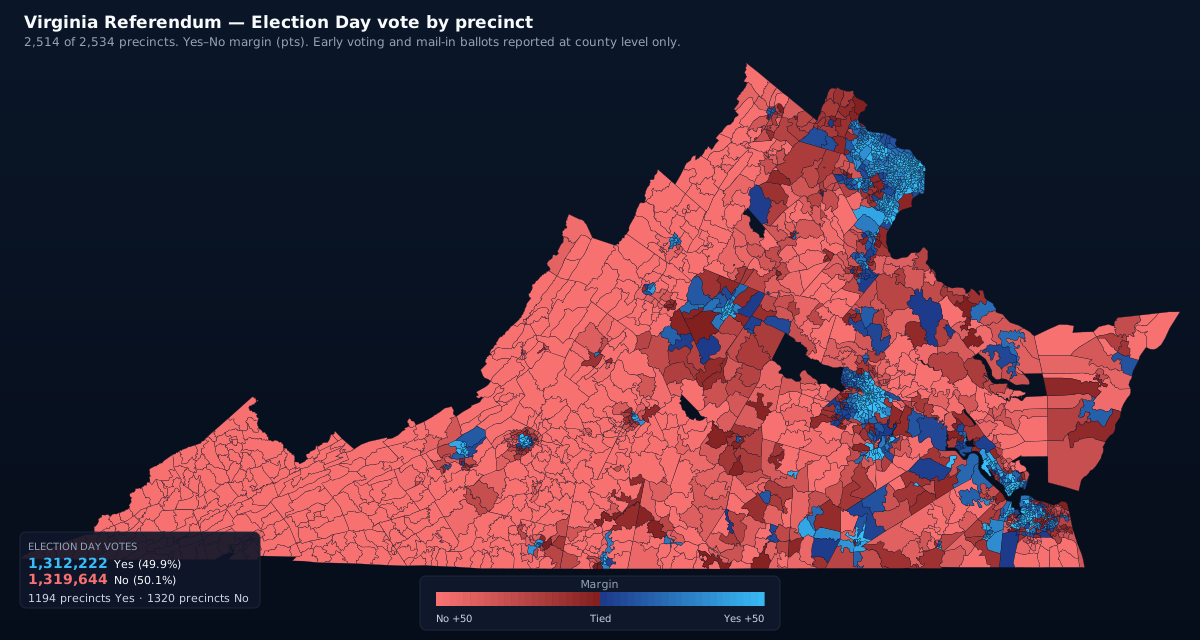
Blue precincts (Yes > No) cluster in exactly the three places Virginia
Democrats always cluster: Northern Virginia's I-66 and I-395 corridors,
the Hampton Roads / James River core, and Richmond-Charlottesville. Red
dominates everywhere else. Yes won only 38 of 133 localities but
carried the state because those 38 include almost all of its population.
The partisan map barely moved. At the locality level, the Yes–No margin
correlates with Spanberger's D–R margin at r = 0.998 and with Harris's
D–R margin at r = 0.996. Every locality that voted D for Spanberger
voted Yes. Every locality that voted R for Earle-Sears voted No. Only a
handful of localities switched sides, all tight.
Where Dems already voted, Yes votes. Where they didn't, No votes.
What changed was who showed up and how hard they pulled. That's where
the coalition story lives.
A 12-Point Gap the Statewide Result Hid
If you zoom out to statewide margins, the three elections look like a
single trend — three snapshots of an increasingly Democratic Virginia:
| Election | D / Yes | R / No | Total | Margin |
|---|---|---|---|---|
| 2024 Presidential (Harris) | 2,335,395 | 2,075,085 | 4,482,576 | D +5.81 |
| 2025 Gubernatorial (Spanberger) | 1,976,857 | 1,449,586 | 3,433,340 | D +15.36 |
| 2026 Referendum (Yes) | 1,575,288 | 1,486,229 | 3,061,517 | Yes +2.91 |
But line them up against each other at the locality level and two
asymmetries jump out:
Concentrated in rural Spanberger-overperformance counties
Concentrated in rural white Virginia; NoVa actually OUTRAN Harris
Against Spanberger, Yes lost ground everywhere — no single locality
outperformed her margin. Against Harris, one region stands out: **Yes ran
ahead of Harris across Northern Virginia, and ran behind Harris in
every other region**. Those two results encode different stories about
what the April 2026 electorate actually was.
!Margin by region: Harris 2024 → Spanberger 2025 → Yes 2026
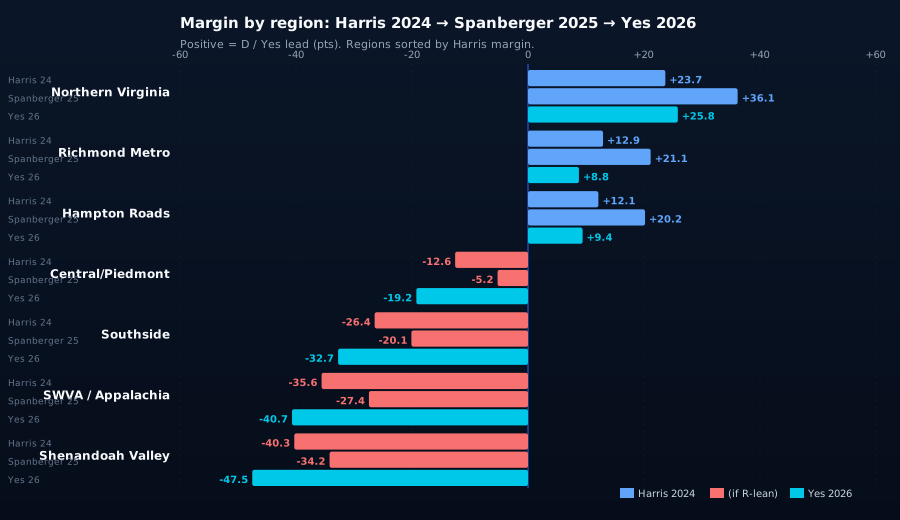
Every region moved D from Harris to Spanberger — a personal-brand
overperformance. But every region except NoVa moved back toward the
partisan middle for the referendum. NoVa held. Understanding why means
looking at who was in the April voter pool.
Where the Composition Changed: Hispanic NoVa
The I-66 and I-95 corridor outside DC is one of the largest Hispanic
population concentrations in the country. Manassas Park is 47% Hispanic.
Manassas City is 44%. Prince William County is 26%. Harrisonburg — down
the Valley but culturally analogous — is 24%.
In 2024, Harris lost ground with Hispanic voters nationally, and Virginia
was no exception. Spanberger recovered that ground in November 2025 with
a moderate, broad-coalition D-base campaign. But in April 2026, low-propensity
Hispanic voters — the marginal Harris coalition voters Spanberger partially
pulled back — mostly stayed home. The electorate that remained was
smaller, older, whiter, wealthier, and more Democratic-reliable.
Result: Yes ran ahead of Harris in exactly those places where Harris's
2024 performance was weakest.
The locality-level pattern is monotonic. Across the 129 localities with
complete data, Hispanic share of population has the strongest
correlation with Yes's swing against Harris of any demographic variable
we measured (Pearson r = +0.75).
!Hispanic share vs Yes swing vs Harris 2024
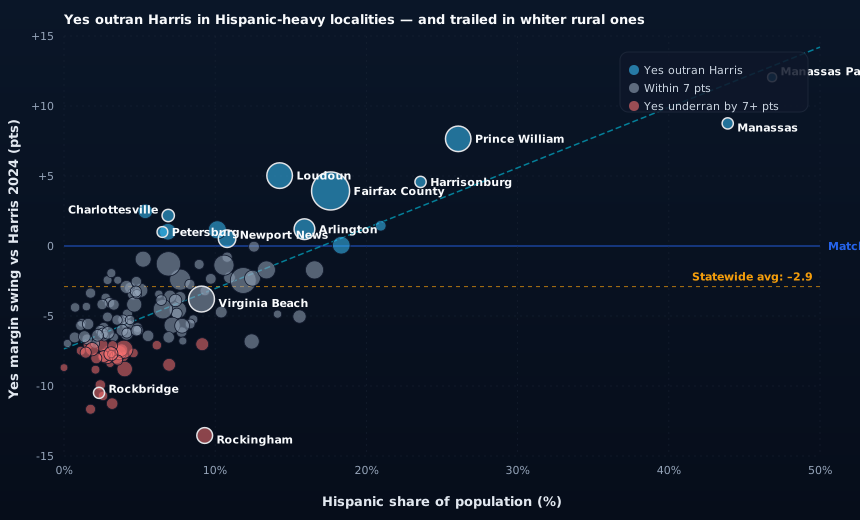
The quintile breakdown makes it starker. The most-Hispanic fifth of
Virginia — 9.3% to 46.8% Hispanic, containing roughly 1.4 million
referendum votes — was the only quintile where Yes outran Harris.
Every less-Hispanic quintile ran behind Harris, and by more as the
Hispanic share fell.
| Hispanic % quintile | Range | Yes swing vs Harris |
|---|---|---|
| Q1 (least Hispanic) | 0.0 – 2.6% | –6.14 pts |
| Q2 | 2.6 – 3.8% | –7.00 pts |
| Q3 | 3.9 – 6.1% | –5.59 pts |
| Q4 | 6.3 – 9.3% | –4.10 pts |
| Q5 (most Hispanic) | 9.3 – 46.8% | +1.26 pts |
The Asian Pocket: Loudoun, Fairfax
Loudoun County is 22% Asian. Fairfax County (including Fairfax City) is
19-20% Asian — the densest Asian American population in the
Mid-Atlantic. These are also the counties where Harris's 2024
performance relative to Biden's 2020 was weakest among Asian voters,
especially among Indian and Vietnamese subgroups.
Same composition story applies. The April 2026 electorate had far fewer
of the low-propensity Asian voters who had held for Biden and drifted
for Harris. What remained was a more Dem-reliable core.
The correlation of Asian share with Yes swing vs Harris is r = +0.61
— second only to Hispanic share. Loudoun, despite only 64% of its
2024 turnout showing up, delivered a 5-point improvement on Harris's
margin.
Rural White Virginia: The Counter-Mobilization
The opposite story plays out in the Valley and Piedmont. Rockingham
County — 84% non-Hispanic white, median age 40, Harrisonburg's
agricultural hinterland — ran **13.5 points behind Harris on the
referendum**. Rockbridge, Augusta, Highland, Bath, Smyth, Wise: all
followed the same pattern.
These localities ran 72–77% of their Pres 2024 turnout — more than
NoVa's 63–65%. The Republican side wasn't depressed; if anything, R
counter-mobilization on an explicit "stop the Democratic gerrymander"
message brought out voters who sit out presidential elections. The No
share in the Valley looks like the R share in a hot midterm, not a
sleepy April special.
Correlations tell the same story. Non-Hispanic white share correlates
with Yes swing vs Harris at r = –0.54. Median age correlates at
r = –0.50. The April 2026 electorate in rural Virginia was whiter,
older, and more anti-amendment than the Trump electorate had been
pro-Trump five months earlier.
The College-Town Exception
There's one compositional pattern that hurts Dems in both comparisons:
student turnout collapses in April specials. Four localities where
Spanberger famously overperformed on student turnout got hammered in
the Yes column:
| Locality | University | Pres 24 | Gov 25 | Yes 26 | Turnout vs Gov |
|---|---|---|---|---|---|
| Montgomery | Virginia Tech | +3.5 | +16.9 | –0.7 | 86% |
| Radford City | Radford U | +0.5 | +12.4 | –4.8 | 87% |
| Harrisonburg City | JMU | +25.4 | +44.4 | +29.9 | 78% |
| Lexington City | W&L / VMI | +36.4 | +36.4 | +23.3 | 88% |
Montgomery County flipped. Radford City flipped. Harrisonburg held but
shed 15 points of margin. These places move on the student vote, and
the student vote can't be mobilized in April when exams and
commencement are weeks away. This is not a durable realignment — it's
an off-cycle scheduling artifact that Democratic House candidates on
November 3, 2026 should not be modeled from.
Hampton Roads: The Dem Machine Held
A fourth pattern deserves attention: **majority-Black Hampton Roads
and Richmond cities held up best against both baselines**. Petersburg
(77% Black) ran only 3.4 points behind Spanberger — the smallest
underperformance of any locality. Portsmouth (51% Black), Hampton
(49%), Newport News (41%), Norfolk (40%), Suffolk (42%) all ran within
10 points of Spanberger and matched or exceeded Harris.
This is a turnout infrastructure story. Cities with established Black
Democratic political operations — ward clubs, churches, labor
affiliates — kept their base voters engaged even for an April special.
Rural majority-Black Southside tells the opposite story: Charles City
(41% Black) dropped 8.8 points vs Harris on 68% turnout; Sussex (54%
Black) and Halifax (35% Black) both underran by 7-8 points as
low-propensity Black voters stayed home. The Dem machine stops at the
Richmond metro line.
What This Means for the 2026 House Midterms
The partisan map on the Virginia referendum is almost indistinguishable
from the Spanberger map. That's superficially reassuring for Democrats:
it confirms the Spanberger coalition is stable as a partisan map, not
a cult of personality. But the **underperformance vs Spanberger is
large and non-random** — 12 points statewide, concentrated in the
exurban counties (Spotsylvania, Culpeper, Fauquier, Louisa, Orange)
and college towns where Spanberger's margin was softest.
Three implications:
**1. Midterm Dem turnout in VA will look more like the April 2026
electorate than the November 2025 electorate.** The composition that
flatters Yes in NoVa — Dem base voters without the marginal Harris
coalition — is the same composition that shows up in a House midterm.
That's good for the 4 new D-leaning seats the map creates; it's less
good for any candidate who needs to pull Spanberger-style
overperformance in exurbs.
**2. The Hispanic/Asian vote is elastic — and turnout-dependent, not
persuasion-dependent.** The Q5 Hispanic quintile outperformed Harris by
registering fewer weak Harris voters, not by winning new voters. To
replicate Spanberger's full margin in 2026, Dems need those marginal
Hispanic and Asian voters physically in the November electorate.
Organizing, not messaging, is the variable.
3. Rural R turnout in Virginia is not dormant. The Valley, Southside,
and SWVA delivered 95%+ of their Gov turnout for an *April special on an
obscure constitutional question*. In a nationalized House midterm, rural
R turnout should be modeled at full November strength, not dropped off.
Ask the Historian
For the full interactive map, a locality-by-locality table, and the
coalition-vs-baselines view, see the dedicated race page:
Methodology
Referendum results pulled from the Virginia Department of Elections
ENR system (enr.elections.virginia.gov) at 2026-04-22 18:51 UTC, with
133 of 133 localities reporting. Presidential 2024 and Gubernatorial
2025 results are from the Akashic Edge elections database, with source
provenance to VA Department of Elections official certifications.
Precinct-level caveat. Virginia publishes precinct-level results
for Election Day votes only (2.63M of 3.06M total ballots). Early
voting, mailed absentee, and provisional ballots — roughly 14% of the
statewide vote — are reported at the locality level only. Our precinct
map above shows Election Day votes exclusively; all statewide and
locality-level margins throughout the article include every mode.
2,514 of 2,534 precincts matched to 2024 Census boundaries (99.2%);
20 Bristol/Goochland/Williamsburg precincts didn't match due to
mid-cycle precinct renaming and are excluded from the map.
Four Virginia county/independent-city pairs with matching names
(Fairfax, Franklin, Richmond, Roanoke) were collapsed for the
comparison analysis to match a known ETL merge in the 2025 Gov load —
129 matched localities in the final comparison dataset.
All margins are computed as (D_votes − R_votes) / total_votes × 100
(or (Yes − No) / total for the referendum), following Akashic Edge's
standard margin convention. Demographic data is 2020 PL 94-171 Census
redistricting data plus ACS 2024 5-year estimates.
Correlations are Pearson, weighted at the locality level (not by vote
volume). Quintile rollups are weighted by referendum vote volume.
Complete 129-locality dataset available at